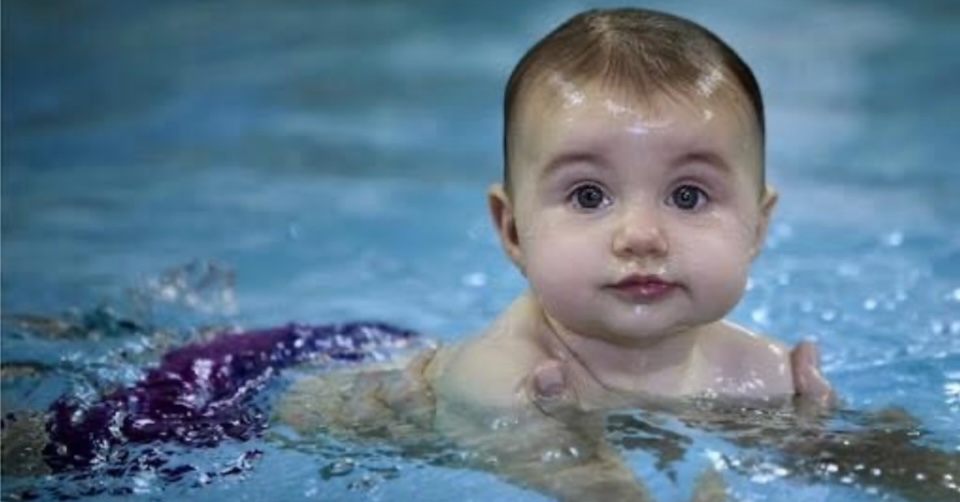
Human beings go through a very complex development process, beginning in utero and continuing for years. Your unborn baby spends the first nine months of life floating in the watery environment of the womb. During birth, aquatic reflexes associated with early swim development are integrated. This makes birth and beyond the perfect time to continue your babies’ relationship with water.
Reflexes or “primitive reflexes” (called this because they are the first to develop) are part of this incredibly important development. These primitive reflexes help the baby develop movement patterns, which in turn spur brain development. They also prepare the baby for the birthing process. Primitive reflexes are present before, and at birth and integrate, or disappear, during the first year of life.

Primitive reflexes are actions originating in the central nervous system that are exhibited by normal infants, but not neurologically intact adults, in response to particular stimuli. These reflexes disappear or are inhibited by the frontal lobes as a child moves through normal child development. Primitive reflexes must fully integrate to allow for the development of the postural reflexes.
Postural reflexes are not present at birth but develop later as a development of a primitive reflex. When the primitive reflexes disappear, the postural ones continue for life. Postural reflexes use a higher part of the brain to function and are a sign of increased maturity of the central nervous system. Postural reflexes allow babies to move from horizontal to vertical standing on their feet and being mobile. If a baby does not complete a reflex stage like crawl, like never crawled, or if the stage was not completed correctly (crawl in an odd position or for a very short period of time) there will be life-long consequences. Continued development of the brain is dependant upon completion of these early steps and of integration of these reflexes.
Most infant reflexes are outgrown after six months, unless they are sustained by regular active stimulation. The first step is to recognise the babies’ reflexes. Different positions are then used to stimulate them, strengthen them and to help the baby to produce them as movements. The more relaxed you are and the earlier you start; the stronger the babies’ swimming reflexes are likely to be. Early swimming provides an opportunity for the baby to move in the water in an ideal way to develop not only a stronger body, but its stimulating effect has the potential to increase intelligence, concentration, alertness and perceptual abilities. The presence of some of the babies’ primitive reflexes is essential for survival. If reflexes persist beyond an expected time, it may indicate a delay in development.

Until about six months, babies placed in water, tummy-side down will move their arms and legs in a swimming motion. This is similar to their motion in their mother’s womb. This is the babies most basic reflex in the water. When the swimming reflex and the dive reflex are both engaged, a baby can look like a natural swimmer. These reflexes do not mean that a baby can swim and do not protect a baby from drowning either. These reflexes eventually loose strength and fades away, but if it is reinforced with practise in the pool, it should be easier for the baby to make the transition from involuntary, reflexive swimming to voluntary, conscious swimming. From three to four months of age to the time the baby learns to walk, the swimming reflex gradually disappears. During this phase, unless the baby has had lots of swimming practise, he may sink below the surface without struggling or using any locomotive movement. If the baby has had swimming lessons, it is more likely that he would kick or pull to safety.
Thus, the earlier a new born baby is re-introduced to water, the reflexes can be stimulated and strengthened through repetition, enhancing the different movements.