
How every splash helps your child learn
Swimming is not simply exercise for children. Every kick, reach, breath and turn gives the brain information to process and respond to. When children learn through movement and play in the water, they are developing skills that can support learning both in and out of the pool.
1. Encourages brain-body connections
Swimming teaches the brain and body to work as a team. Every movement in the water gives the brain information about where the body is, how it is moving and what it needs to do next.
Coordinating multiple movements
Swimming requires the brain to coordinate the arms, legs, breathing and body position at the same time. The brain learns to coordinate these movements smoothly. This also helps children practise motor planning and coordination.
Developing body awareness
Water feels different from the air. Children learn how their body moves, floats, sinks, turns and changes position. This helps develop proprioception and body awareness.
Improving balance and stability
Because water supports the body differently from the ground, children must constantly adjust their position. Their brains receive information from the muscles, joints and balance system and use it to make corrections.
Learning motor patterns
When children repeatedly practise movements such as kicking, floating and reaching, the brain becomes better at remembering and organising
those movements. With practise, movements can become more automatic.
Connecting movement with breathing
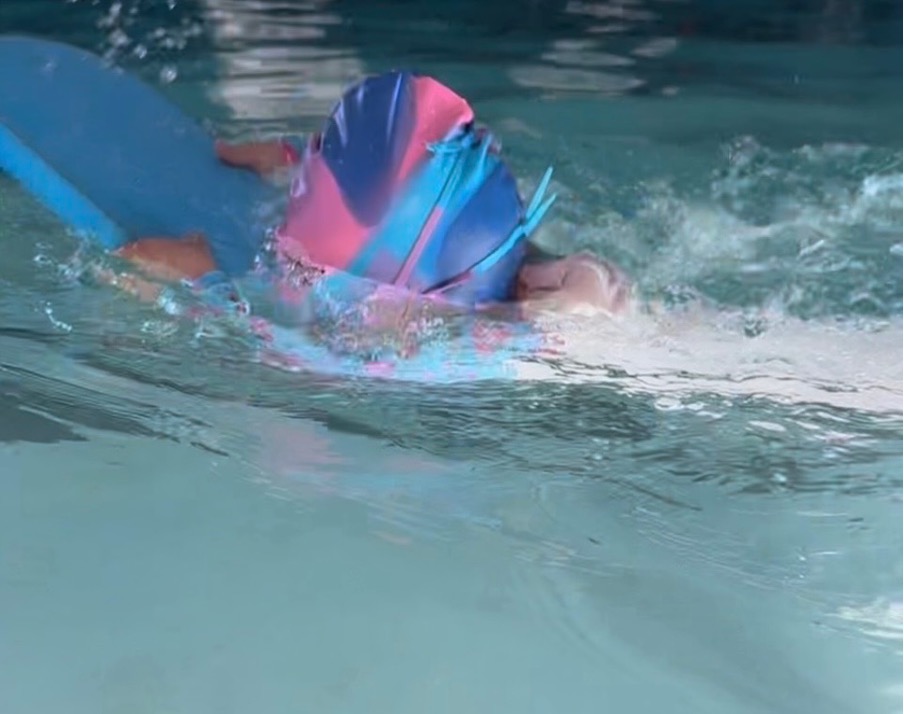
Swimming teaches children to coordinate breathing with movement – for example, turning the head to breathe (freestyle) while continuing to kick. This requires timing and concentration.
Responding to the environment
Children need to react to the water around them. They learn to adjust their movements depending on whether they are floating, pushing off the wall, changing direction or moving through deeper water,
2. Supports concentration, attention and memory
Swimming is not just about moving through the water. Children are constantly listening, watching, remembering and responding. Each lesson gives them an opportunity to practise focus, attention and learning through movement.
Children learn to listen carefully
During lessons, children need to pay attention to instructions such as “kick your legs’’ or ‘’blow bubbles,’’ or ‘’reach for the wall.’’ This encourages them to focus on the task in front of them.
Swimming requires focus on several things at once
A child may need to think about their arm movements, kicking, breathing and body position simultaneously. This helps practise sustained attention and mental focus.
Repetition strengthens attention
Swimming skills are often practised repeatedly. Repetition encourages children to stay focused on a task long enough to improve it.
The water provides a different sensory environment
The feeling of water, movement and resistance gives children lots of sensory information to process. They learn to focus on relevant information while performing a movement.
Children learn to follow sequences
Remembering and completing a sequence requires attention and working memory. For example: push off – kick – reach – breathe.
It teaches children to stay focused despite challenges
A new skill may not work the first attempt. Swimming encourages children to concentrate, try again and make small adjustments until they succeed.
Progress can build motivation
When children see themselves mastering a skill, they are often more motivated to stay engaged and concentrate on learning the next one.
3. Strengthens problem – solving skills
Swimming gives children opportunities to ask, ‘’What can I do differently?’’ They learn to observe, try, adjust and try again – an approach to problem-solving that can be useful beyond the swimming pool.
In water, children constantly make small adjustments – how hard to kick, how to balance, how to turn or how to reach the wall. This gives them opportunities to develop problem-solving and adaptability.
Children learn to adjust their movements
If a child is not moving forward effectively, they may need to work out how to kick differently, change their arm movement or improve their body position. They learn that changing their approach can change the result.
They learn through trial and error
Swimming involves trying a skill, seeing what happens and trying again. This teaches children that making a mistake is not failure – it is part of learning and finding a better solution.
They learn to overcome challenges
A child may struggle to float, coordinate breathing or reach the wall. With encouragement, they learn to break the challenge into smaller steps and work towards a solution.
Swimming develops decision-making
Children gradually learn to make decisions about their movements – for example, when to breathe, when to turn, how strongly to kick or how to position their body.
It encourages adaptability
Water does not always feel or behave the same way. Children learn to adjust when they change direction, move through deeper water or try a new skill.
They learn to follow sequences
Completing a swimming skill often requires several steps in the correct order. Remembering and organising those steps helps develop planning and problem-solving.
4. Provides rich sensory experiences
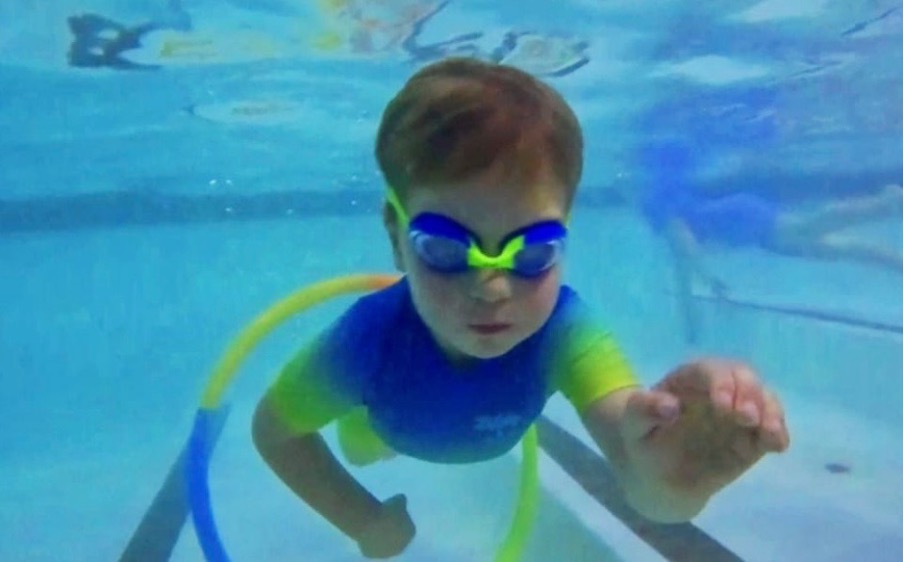
Swimming gives your child’s brain a whole world of sensory information. Water gives children different sensations of pressure, temperature, movement and resistance. These experiences provide the developing brain with information about the body and its surroundings. Every splash, float, kick and turn helps them discover how their body moves and responds to the water.
Water pressure provides sensory input
Water gently presses against the body as a child moves. This gives the brain information about where the body is and how it is moving.
Children develop body awareness
Floating, kicking, turning and reaching help children understand the position of different parts of their bodies. This supports proprioception – the body’s awareness of its position and movement.
Movement stimulates the balance system
Rolling, turning, floating and changing direction in water provide movement experiences that engage the vestibular system, which contributes to balance and spatial awareness.
Water resistance provides feedback
Children can feel that moving their arms and legs through the water is different from moving them through air. They learn how changing the strength or direction of a movement affects what happens.
Temperature provides sensory information
The sensation of entering and moving through water gives the brain information about temperature and helps children become familiar with different physical sensations.
Sound and touch add to the experience
Water sounds, splashing, bubbles and the sensation of water moving around the body all provide additional sensory information.
It encourages sensory exploration
Young children can explore what happens when they splash, blow bubbles, float, kick or change position. This turns the swimming environment into a hands-on-learning experience.

5. Builds confidence and resilience
Swimming can be a wonderful way for children to develop confidence and resilience because it gives them regular opportunities to face challenges, practise new skills and experience success. Learning a new swimming skill can be challenging. When children practise, make mistakes and eventually succeed, they learn an important lesson: “I can keep trying.” This can support confidence and persistence. Confidence comes from experiencing success, while resilience develops from learning how to keep going when something is difficult.
Learning new skills creates a sense of achievement
When a child learns to float, put their face in the water, swim a distance or climb out of the pool, they experience the satisfaction of mastering something that was once difficult.
It teaches children that progress takes time
Swimming skills don’t usually develop overnight. Children learn that practise, patience and repetition can lead to improvement.
Children learn to cope with mistakes
A child may struggle with a particular skill or get something wrong. Swimming provides a safe opportunity to try again and learn that mistakes are a normal part of learning.
Small successes build self-belief
Achieving small milestones such as blowing bubbles independently or swimming a few metres can gradually build the belief: ‘’I can do this.’’
It encourages perseverance
Some skills require many attempts. Children learn to keep trying even when something feels difficult, helping develop persistence and resilience.
Children become more independent
As children become more capable in the water, they can do more for themselves/ This growing independence can strengthen their confidence.
They learn to manage challenges
A supportive swimming lesson can teach children to stay calm, listen, try different approaches and ask for help when needed.
6. Supports executive function skills
Executive functions are important for everyday activities such as learning, following instructions, managing emotions, solving problems and completing tasks.
Swimming lessons can involve following instructions. Waiting for a turn, remembering sequences and controlling impulses – all skills related to developing self-regulation and executive functioning. Swimming does not automatically improve executive-function abilities, but the learning environment gives children repeated opportunities to practise these skills while doing something active and enjoyable.
Working memory
Children need to remember instructions and movement sequences, such as kick, reach, breathe. They then have to hold that information in mind while performing the skill.
Inhibitory control
Children learn to wait for their turn, stop when instructed and control impulsive movements. This helps them practise self-control.
Mental flexibility
If a movement is not working, children may need to change their technique or try a different approach. This encourages flexible thinking.
Planning and sequencing
Swimming skills often involve completing several actions in a particular order. Learning these sequences encourages children to plan, organise and follow steps.
Sustained attention
Children need to stay focused throughout a lesson, listen to their instructor and concentrate on performing a skill correctly.
Self-monitoring
Children gradually learn to notice things such as, ‘’My legs aren’t kicking,’’ or ‘’I need to turn my head to breathe.’’ They can then make adjustments.
Goal setting and persistence
Working towards a goal – such as floating independently or swimming a certain distance – teaches children to work towards something over time and keep trying when it is challenging.
Swimming is not only building a stronger body – it is helping to build a stronger, more capable and confident brain.